Administrative Directorate
Directorate of Information and Communication Technology
Strategic Mandate
Mandate Statement: To serve as the definitive catalyst for digital transformation at the Nigerian Defence Academy by designing, deploying, and maintaining a secure, modern, and high-availability digital ecosystem. As a mission-critical service unit, DICT is mandated to provide seamless technological enablement, data-driven decision support, and advanced tactical capabilities to empower the Academy's academic, administrative, and military operations.
Core Pillars of the Mandate
To execute this mandate effectively, DICT's authority and operational scope are divided into five strategic pillars, driven by its specialized sub-units:
1. Enterprise Connectivity and Cyber-Resilient Infrastructure
DICT is mandated to build and safeguard the physical and wireless highway of the Academy. Connectivity must be treated as a utility always on, highly secure, and deeply scalable.
- Continuous Optimization: Design and maintain a robust campus-wide network architecture capable of handling intensive data traffic, e-learning platforms, and secure military communications.
- Proactive Lifecycle Management: Systematically evaluate hardware, deploy timely software upgrades, and minimize technical downtime through rigorous preventative maintenance of ICT and telephone assets.
- Cyber-Security Integration: Ensure that all network deployments are hard-coded with modern protocols to shield institutional data from emerging cyber threats.
2. Data-Driven Governance & Decision Support Systems
In modern institutional administration, data is a strategic asset. DICT is mandated to transition the NDA from reactive reporting to predictive, data-informed leadership.
- Unified Database Administration: Centralize and secure all student, cadet, personnel, and financial records into high-integrity management systems.
- Advanced Analytics: Empower the Academy’s leadership with active decision support frameworks, transforming raw administrative and academic metrics into actionable intelligence.
- Dynamic Information Dissemination: Manage and continuously modernize the Academy's public and internal web infrastructure to maintain clear, reliable global communication.
3. Next-Generation Pedagogy and Digital Literacy
As an academic institution, DICT serves as the engine room for modern learning, ensuring that both instructors and learners have the digital tools required to excel.
- Institutional Capacity Building: Program and deliver rigorous ICT and digital literacy training tailored specifically for military staff, civilian personnel, and cadets.
- E-Learning Frameworks: Develop, host, and optimize robust e-learning systems that allow for flexible, hybrid learning models.
- Inclusive Technology Support: Curate and manage accessible multimedia services, ensuring specialized assistive technologies are available to support users with diverse learning needs.
4. Autonomous Systems and Tactical Aerial Capabilities
Unique to a defense-focused institution, DICT is mandated to pioneer the intersection of consumer technology and tactical defense applications.
- Surveillance & Security Support: Provide high-resolution aerial mapping, real-time intelligence gathering, and surveillance arrays to reinforce the physical security of the Academy.
- Unmanned Systems Competency: Conduct standardized, cutting-edge training on Unmanned Aerial Systems (UAS), ensuring cadets graduate with practical command over drone technologies.
- Operational Archiving: Deliver comprehensive, multi-angle aerial coverage for all high-profile tactical training exercises, field maneuvers, and institutional events.
5. Fiscal Stewardship and Administrative Excellence
DICT is mandated to manage its internal workflows and resource allocations with extreme precision, setting an institutional standard for accountability.
- Asset Accountability: Maintain a definitive, documented inventory of all ICT assets, mapping out clear depreciation and replacement lifecycles.
- Budget Optimization: Strategically align the Directorate's financial planning, budgeting, and internal auditing to maximize the return on every technology investment.
2026 Strategic Evolution: Alignment with ICT Trends
To prevent technological obsolescence, DICT explicitly incorporates current enterprise trends into its daily service delivery:
- Cloud Integration: Shifting from heavy on-premise physical servers to agile, hybrid-cloud configurations to guarantee that academic portals and administrative databases remain accessible anywhere, anytime, with zero localized downtime.
- Automation of Workflows: Phasing out manual paper routing within the NDA administration by building customized, automated software pipelines through the Chief System Analyst (CSA) and Chief System Engineer (CSE).
- Predictive Asset Tracking: Moving from a "break-fix" maintenance approach to an intelligence-driven, predictive maintenance cycle for all hardware, significantly extending the lifespan of the Academy's physical tech investments.
Leadership
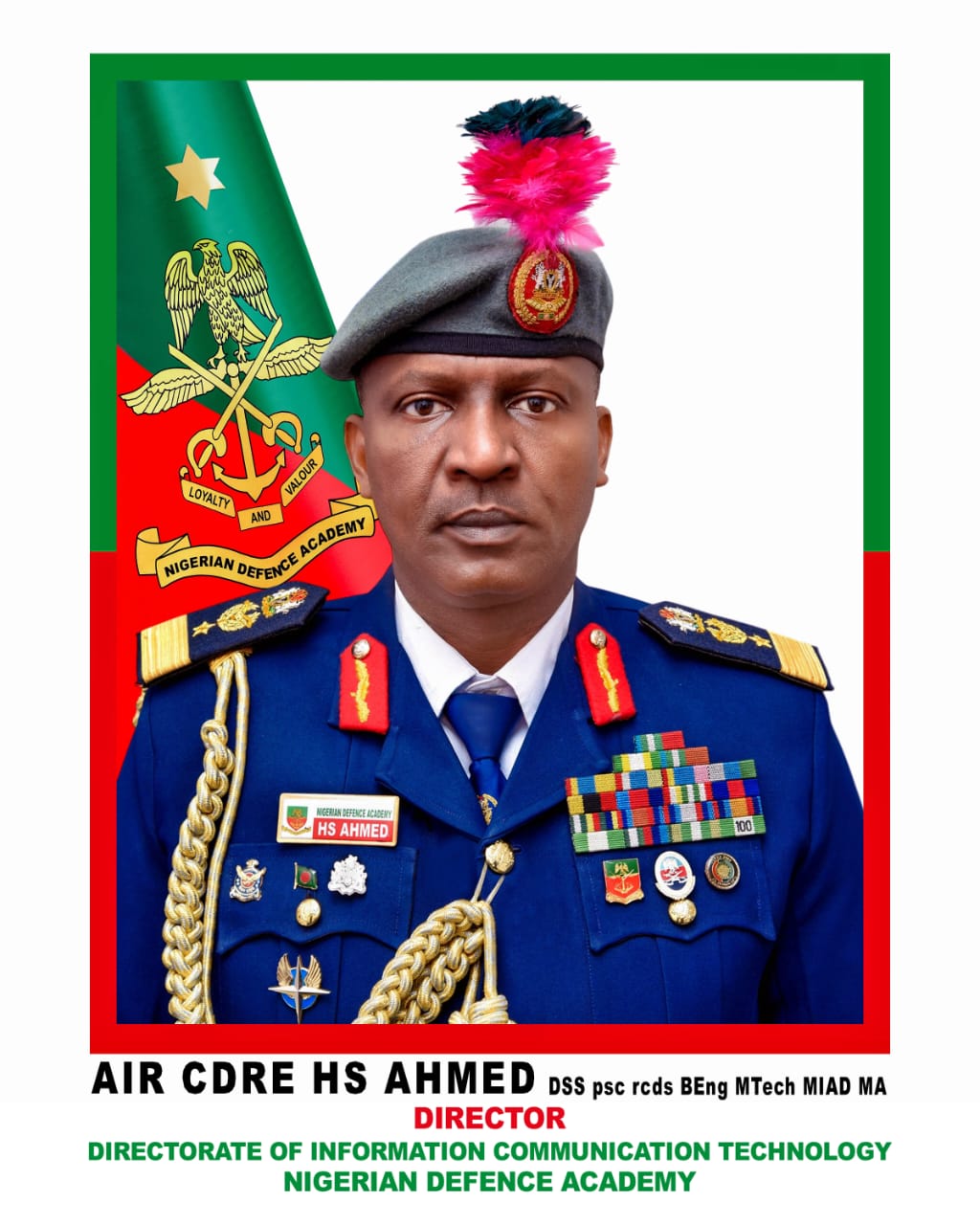
The Directorate is headed by a Director from the Nigerian Air Force, a position established as an Air Commodore billet.
Team Structure
To execute its mission, the Director is supported by a highly skilled, integrated team of military and civilian professionals, including:
- Military Staff Officers: Serving at the SO I and SO II levels to support strategic and operational goals.
- Chief System Analyst (CSA): A senior civilian officer responsible for overseeing the lifecycle of all software-related systems and applications across the Academy.
- Chief System Engineer (CSE): A senior civilian officer who works alongside the CSA to manage the Academy's core technical systems.
Units
Units of Directorate of Information and Communication Technology
Explore each unit and its head of unit.
Unit
Administration and Finance Unit
The Administration and Finance Unit provides the essential operational and fiscal backbone of the Directorate. Headed by...
Unit
Equipment Maintenance and Support Services Unit
The Equipment Maintenance and Support Services Unit ensures the operational readiness, reliability, and accountability o...
Unit
Management Information System (MIS)
The Management Information System (MIS) Unit is dedicated to maintaining the data integrity, academic systems, and digit...
Unit
Multimedia Services Unit
The Multimedia Services Unit focuses on enriching the Academy’s educational environment through modern digital media and...
Unit
NDA Drone Squadron
The NDA Drone Squadron provides advanced aerial capabilities, tactical surveillance, and specialized unmanned systems tr...
Unit
Network Infrastructure Unit
The Network Infrastructure Unit provides the critical baseline connectivity and hardware backbone for the entire institu...
Unit
Training and Support Unit
The Training and Support Unit focuses on capacity building, digital education, and technical assistance across the Acade...
Staff profiles for this directorate will be published shortly.